
Afro Hair Transplant in Turkey
Afro hair transplant in Turkey pairs curved-punch FUE and DHI techniques with specialist surgeons, delivering 90-95 % graft survival at prices that average $2900 – 3200 for an all-inclusive package.
Clinics in Turkey provide medical teams familiar with these complex anatomical structures. The afro hair transplant in Turkey procedure involves extracting grafts from the donor area and implanting them into bald patches. Recovery times and post-operative care remain similar to standard hair transplantation procedures. Patients must follow specific washing routines to maintain graft survival during healing.
Why Adem Köse For Afro Hair Transplant in Turkey?
Choosing Adem Köse for an Afro hair transplant in Istanbul mainly comes down to three measurable points—tool-set, price band, and publicly available patient feedback—rather than brand hype.
Technique & workflow
We advertises curved-punch FUE combined with DHI implantation to follow the C-shaped curl pattern and lower graft transection. While this set-up is common in Turkey’s textured-hair centres, you should still ask to see the punches and confirm that the surgeon, not a technician, controls depth and angle during harvesting.
2026 pricing
All-inclusive Afro packages (hotel, transfers, PRP) list between US $2,900 – 3,200 on comparison sites, with outliers from $2,000 up to $5,000 depending on graft count and extras. That translates to roughly TL 110,000 – 223,000 at the April 6 2026 exchange rate.
Patient sentiment
- Independent aggregator MyHair shows a 4.9 / 5 score from 338 reviews, indicating generally positive experiences.
- Complaint portal Şikayetvar contains several unresolved posts about design disagreements and poor growth.
- Reading both sets of comments (and asking the clinic to explain how they handle revisions) gives a clearer picture than relying on before-and-after photos alone.
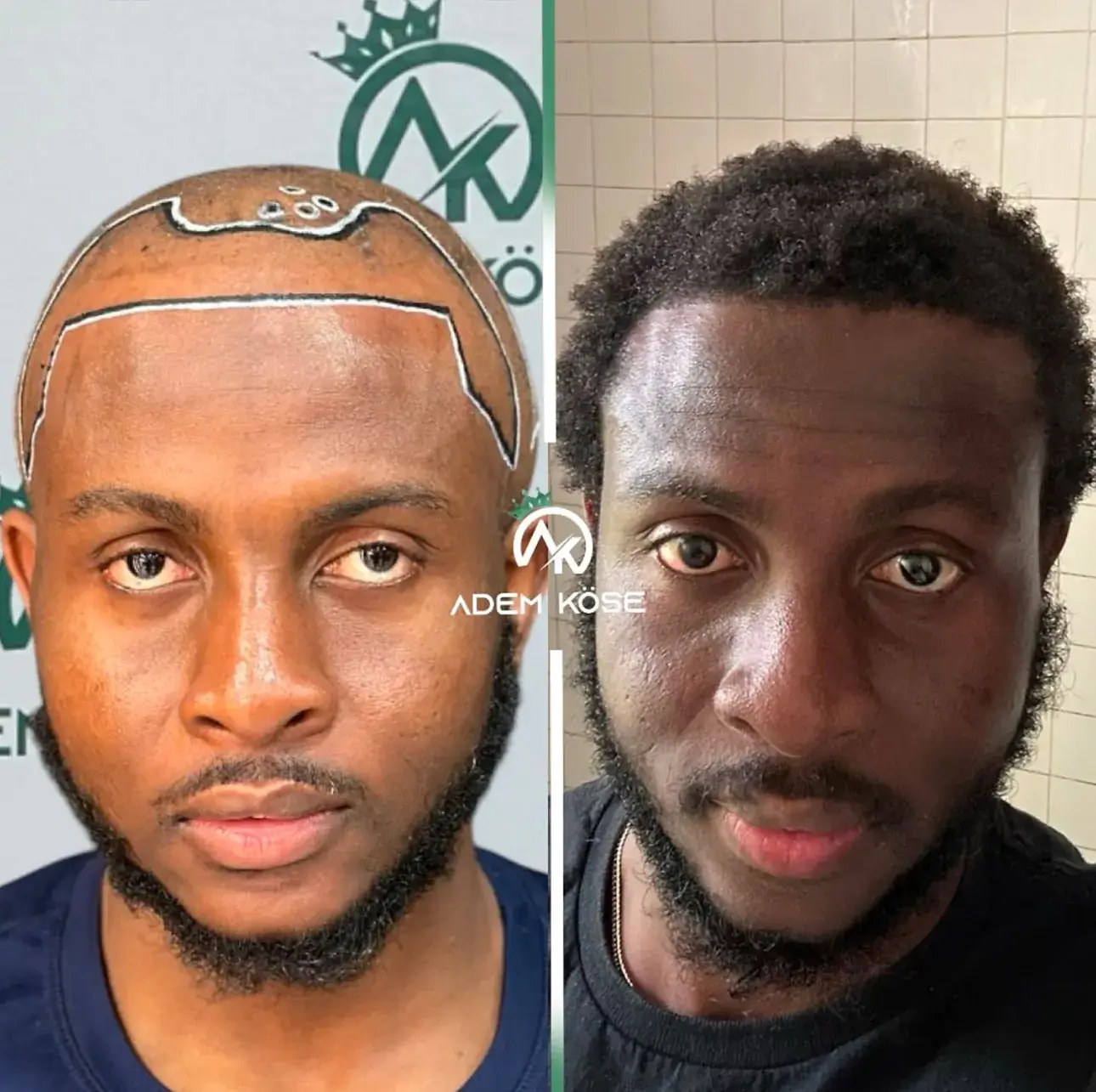
What is Afro Hair Transplant?
An Afro hair transplant is a hair restoration procedure designed specifically for people with tightly coiled, curly hair (often of African or Afro-Caribbean descent).
Because Afro-textured hair has a curved shaft above the scalp and a more curved follicle under the skin, the surgeon must use techniques and tools that protect the grafts and match the natural curl pattern. Clinics typically perform it with FUE (follicular unit extraction) or DHI, but with extra attention to punch size, extraction angle, and implantation direction so the result looks natural and dense.
Why Choose Afro Hair Transplant in Turkey?
People often choose Afro hair transplant in Turkey because the country offers textured-hair expertise, transparent mid-tier pricing, and travel logistics that are easier than many alternatives.
Key points:
- Specialised techniques are common. Clinics in İstanbul handle a steady stream of international patients with tightly coiled hair, so curved-punch FUE and DHI tools are part of the routine rather than an exception.
- Total cost stays moderate. A typical 2 000-to-2 500-graft package—including surgery, three-night hotel stay, airport transfers, and basic after-care, lands between USD 2 500 and 3 500. That is well below UK or US quotes, even after flights.
- One-stop packages reduce planning. Most centres bundle transport, accommodation, blood work, and follow-up video calls. Travellers who prefer to self-organise can usually opt out of extras and pay a lower surgery-only fee.
- Regulatory framework exists. Licensed hair-transplant clinics operate under the Turkish Ministry of Health; larger hospitals also pursue ISO or Joint Commission accreditation. Patients should still verify paperwork, but a formal oversight channel is available.
- Language support is standard. English-speaking coordinators are common, and many clinics add French or Arabic staff to minimise miscommunication during consent and post-op instructions.
- Flight access is broad. Turkey’s main airports handle direct routes from North America, Europe, and Africa, keeping travel time (and jet-lag recovery) manageable for most visitors.
Afro Hair Transplant in Turkey Packages
| Package tier | Typical graft range | Main technique | What’s included | Best for |
|---|---|---|---|---|
| Surgery-only | 1500 – 2000 | Curved-punch FUE | Procedure, local anaesthesia, day-one medical kit | Travellers who will book their own hotel and have limited thinning |
| Standard | 2000 – 2500 | Hybrid FUE + DHI | Procedure, 3-4★ hotel (2–3 nights), airport transfers, first PRP session, medication pack | Patients wanting basic comfort and moderate coverage |
| Premium / Long-DHI | 2500 – 3000 + | Full-session DHI | Procedure, 5★ hotel, VIP transfers, PRP + home LLLT device, 12-month online follow-up | Wide hair-loss cases that need maximum density and ongoing support |
Why is Afro Hair Structure Unique?
Afro hair creates a more tightly curled and voluminous appearance compared to most other hair types. However, the most critical aspect of this structure is that the hair root is also not straight. The hair root, which curves beneath the skin, requires more sensitive handling during the extraction phase than classic straight hair types. If this anatomical structure is not considered, grafts may be damaged, and the transplant efficiency can decrease.
Another significant difference is the volume-building power of afro hair. While more grafts might be needed to achieve a certain density in straight hair, afro hair can be perceived as more voluminous due to its curly nature. This situation can provide an advantage when planning is done correctly. However, making a decision based solely on the surface volume of the hair is not accurate. The donor area, hair thickness, shedding level, and the targeted image should be evaluated together.
Who is it Suitable For?
Afro hair transplantation is suitable for male and female candidates who have sufficient curly follicle density in the donor area, whose hair loss has become permanent, and whose general health status is stable.
Suitable Candidate Profile
- Those experiencing permanent hair loss: If androgenetic or traction-type hair loss has stopped progressing for 12 months, a procedure can be planned.
- Those with a strong donor area: If the spiral follicle density on the nape and above the ears is ≥ 45 grafts/cm², safe extraction is performed with curved punch FUE.
- Individuals with an elastic scalp: When elasticity is high, the risk of breakage while removing grafts decreases.
- Those who want hair styling freedom: Permanent curly density allows you to recreate styles such as braids, twists, and dreadlocks.
- Those who are eligible in terms of health: Conditions such as diabetes, hypertension, and anemia are under control; there is no history of active skin infection or keloid formation.
Situations Requiring Caution
- Active keloid tendency: If the risk of excessive scar tissue is high, professional clearance is required before the transplant.
- Allergic dermatitis or psoriasis flare-up: Remission must be achieved first through dermatological treatment.
- Insufficient donor density: If diffuse thinning has spread to the nape, other options (e.g., SMP or hair prosthesis) are preferred.
- Early age: Since the rate of hair loss is not fully clear in patients under the age of 22, the possibility of revision increases.
Why Does Afro Hair Transplantation Require Experience?
The most fundamental factor that makes afro hair transplantation difficult is the curved structure of the hair root under the skin. If the direction of the root is not correctly estimated during graft extraction, the hair root can break or be damaged. This directly affects the success of the transplant. Therefore, the team working on afro hair transplantation must have experience specifically in working with curly and afro hair structures, not just general hair transplant experience.
In addition, the hairline creation phase requires separate proficiency. An afro hairline is not planned in the same way for everyone. Face type, existing hair structure, age, and the natural exit character of the hair should be evaluated together. Lines that are planned too straight, too sharp, or too far forward may not look natural. For this reason, aesthetic planning is as important as technical success.
How is the Pre-Evaluation for Afro Hair Transplant Conducted?
A detailed analysis must be performed before an afro hair transplant. First, the level of hair loss is evaluated. The areas where thinning is concentrated, how far the hairline has receded, and the condition of the vertex area are examined. Then, the donor area is checked. The hair density at the nape, hair strand thickness, and the capacity of grafts that can be taken are determined.
In this evaluation, not only the number of hairs but also the structural characteristics of the hair are important. The degree of curl of the roots, the volume-giving power of the hair, and the natural direction affect the planning. In addition, whether the person has had a hair transplant in the past, the presence of scars on the scalp, and the general health status should be taken into account. The most accurate planning for afro hair transplantation is made with this detailed preliminary analysis.
Why is the Hairline Important in Afro Hair Transplants?
The hairline is the most visible aesthetic area of a hair transplant. In the afro hair type, hairline planning should be done much more carefully. Because curly hair naturally looks voluminous, even a small planning error made on the front line can become very prominent. A natural afro hairline should not look too straight or as if it were drawn with a ruler. It should be planned in a softer way, compatible with the face and suitable for the person’s age.
In addition, if the hairline is planned too far forward, the donor area may be unnecessarily strained. If it is left too far back, the desired aesthetic effect may not occur. Establishing this balance is one of the most important stages of afro hair transplant planning. A correct hairline plays a decisive role in the natural appearance of the transplant result.
Donor Area Management in Afro Hair Transplants
The donor area is the primary resource for hair transplantation. In the afro hair structure, donor area management is even more important. Because the roots taken are curved, every graft must be protected. If unplanned extraction is performed, both root loss can occur and an irregular appearance can be created in the nape area. Therefore, the donor area should be used in a balanced manner and long-term thinking is required.
Since afro hair is curly, in some cases, a fuller appearance can be obtained with fewer grafts. If this advantage is used correctly, the donor area is managed more efficiently. However, this situation does not work the same for everyone. The capacity of the donor area, hair strand thickness, and the growth strength of the hair must be evaluated together.
Post-Procedure Recovery Process
The recovery process after an afro hair transplant progresses similarly to the general hair transplant recovery logic. In the first days, redness, sensitivity, and crusting can be seen on the scalp. During this period, the transplanted area must be protected, the first wash instructions must be followed, and the recommended care process must be carefully monitored. It is especially important that the transplanted hair roots do not receive any impact in the first days.
With the shedding of the scabs, a more comfortable appearance occurs. Temporary shedding may be experienced in the following process. This period is one of the natural stages frequently seen in people who have had a hair transplant. The growth of new hair happens over time. In the afro hair structure, the development may be perceived differently by some people due to the curly growth character. Therefore, the process should be followed with patience.
Afro Hair Transplant Comparison
Since afro hair transplantation requires a special curved punch technique for curly follicles, it differs from classic (straight) hair transplantation in terms of both equipment and planning. The following table quickly summarizes the most important differences between the İki procedures:
| Criterion | Afro Hair Transplant | Standard Hair Transplant |
|---|---|---|
| Follicle Structure | Spiral / curly; exit direction varies | Straight or slightly wavy; exit direction is stable |
| Graft Extraction Tool | 0.8 mm curved punch, low speed | 0.7-0.9 mm straight punch, standard speed |
| Transection (Root Breakage) Rate | 3-6% with an experienced team | 2-4% with an experienced team |
| Required Density (grafts/cm²) | 30-35 (voluminous strands provide camouflage) | 40-50 |
| Keloid Risk | Higher; trauma minimization is critical | Low-medium; standard measures are sufficient |
| Procedure Time | +1-2 hours longer (complex angle adjustment) | Shorter |
| Technical Difficulty | High – experienced practitioner required | Medium |
| Recovery Speed | Similar, but keloid monitoring may be needed | Standard protocol |
| Cost | 10-20% more expensive | Base reference price |
| Success Rate (12-18 months) | 85-95% graft retention | 90-95% graft retention |
Why Choose Adem Köse?
The primary reason for choosing Adem Köse is the high success rate proven in challenging procedures such as unshaven FUE/DHI and afro hair transplantation, and the priority given to patient safety.
Advantages:
- Professional experience – A portfolio of 50+ afro hair and 700+ unshaven transplants within over 6,000 cases shows mastery in different hair types.
- Curved punch & Long-DHI technology – 0.8 mm curved punch sets and choi implanter pens that protect spiral follicles reduce root breakage to 3-6%; this rate is considered the “gold standard” in the sector.
- International accreditation – The center’s sterilization and patient safety protocols comply with international guidelines; official licensing and regular inspections provide extra assurance.
- Transparent price-graft planning – In afro hair, the limit of 30-35 grafts per cm² and 1,500-3,000 grafts in unshaven transplantation is clearly stated; no hidden fees arise.
- VIP comfort package – It facilitates the recovery process with airport transfer, 4-star hotel, PRP/LLLT supported care kit, and 12-month online follow-up.
Afro Hair Transplant in Turkey Prices 2026
Afro hair transplant in Turkey prices for 2026 start around $1,800 and peak near $5,000, with most patients paying $2,900 – $3,200 for an all-inclusive package:
| Graft Range | Preferred Technique | Package Scope | 2026 Price (USD) |
|---|---|---|---|
| 1500 – 2000 | Curved FUE | Operation only | 1,800 – 3,000 |
| 2000 – 2500 | DHI + PRP | Operation + 3★ hotel + VIP transfer | 3,000 – 4,000 |
| 2500 – 3000 | Long-DHI | VIP (5★ hotel + LLLT + 12-month online follow-up) | 4,000 – 5,000 |
Frequently Asked Questions
[faq-schema id=”3292″]

